NSK300 Real Question - Brain NSK300 Exam
Wiki Article
BTW, DOWNLOAD part of BraindumpStudy NSK300 dumps from Cloud Storage: https://drive.google.com/open?id=1JwJJbpm2vaew-i3nmx0bqq6IO4pnvkHn
The Netskope NSK300 certification provides is beneficial to accelerate your career in the tech sector. Today, the NSK300 is a fantastic choice to get high-paying jobs and promotions, and to achieve it, you must crack the challenging Netskope exam. It is critical to prepare with actual NSK300 Exam Questions if you have less time and want to clear the test in a short time. You will fail and waste time and money if you do not prepare with real and updated Netskope NSK300 Questions.
Netskope NSK300 Exam Syllabus Topics:
| Topic | Details |
|---|---|
| Topic 1 |
|
| Topic 2 |
|
| Topic 3 |
|
| Topic 4 |
|
| Topic 5 |
|
Brain Netskope NSK300 Exam, Certification NSK300 Torrent
In traditional views, NSK300 practice materials need you to spare a large amount of time on them to accumulate the useful knowledge may appearing in the real exam. However, our NSK300 learning questions are not doing that way. According to data from former exam candidates, the passing rate has up to 98 to 100 percent. There are adequate content to help you pass the NSK300 Exam with least time and money.
Netskope Certified Cloud Security Architect Sample Questions (Q57-Q62):
NEW QUESTION # 57
You have an NG-SWG customer that currently steers all Web traffic to Netskope using the Netskope Client. They have identified one new native application on Windows devices that is a certificate-pinned application. Users are not able to access the application due to certificate pinning. The customer wants to configure the Netskope Client so that the traffic from the application is steered to Netskope and the application works as expected.
Which two methods would satisfy the requirements? (Choose two.)
- A. Configure domain exceptions in the steering configuration for the domains used by the native application.
- B. Tunnel traffic to Netskope and bypass traffic inspection at the Netskope proxy.
- C. Bypass traffic using the bypass action in the Real-time Protection policy.
- D. Configure the SSL Do Not Decrypt policy to not decrypt traffic for domains used by the native application.
Answer: A,D
Explanation:
To address the issue of a certificate-pinned application not being accessible due to certificate pinning, while still steering the traffic to Netskope, the two methods that would satisfy the requirements are:
B: Configure the SSL Do Not Decrypt policy to not decrypt traffic for domains used by the native application. This ensures that the SSL traffic for the specified domains is not decrypted, thus avoiding issues with certificate pinning.
C: Configure domain exceptions in the steering configuration for the domains used by the native application. By setting domain exceptions, traffic to these domains will bypass SSL decryption, allowing the certificate-pinned application to function as expected1.
These methods are in line with Netskope's capabilities for handling certificate-pinned applications, which often require bypassing decryption to prevent breaking the application's functionality due to its security features1.
NEW QUESTION # 58
A hospital has a patient form that they share with their patients over Gmail. The blank form can be freely shared among anyone. However, if the form has any information filled out. the document is considered confidential.
Which rule type should be used in the DLP profile to match such a document?
- A. Use predefined DLP Rule(s) that match the patient name.
- B. Use Exact Match with patient names
- C. Use a dictionary rule for all your patient names.
- D. Use fingerprint classification.
Answer: D
Explanation:
The appropriate rule type to use in the DLP profile for a document that is considered confidential when filled out is fingerprint classification. Fingerprinting is a method used to identify and protect sensitive data within documents. It works by creating a digital fingerprint of a file, which can then be used to detect any copies or derivatives of that file. In this case, fingerprinting would allow the hospital to differentiate between the blank patient form, which can be freely shared, and the same form with patient information filled out, which is confidential1.
NEW QUESTION # 59
Your customer is currently using Directory Importer with Active Directory (AD) to provision users to Nelskope. They have recently acquired three new companies (A. B. and C) and want to onboard users from the companies onto the NetsKope platform. Information about the companies is shown below.
- Company A uses Active Directory.
-- Company B uses Azure AD.
-- Company C uses Okta Universal Directory.
Which statement is correct in this scenario?
- A. Either Company B or Company C users cannot be provisioned because integration with only one SCIM solution is allowed.
- B. Users from Companies A. B, and C can be provisioned to Netskope by deploying additional AD Importers and integrating more than one SCIM solution.
- C. Users from Company B and Company C cannot be provisioned because the customer is already using AD Importer.
- D. Company A users cannot be provisioned to Netskope because the customer is already using AD Importer to import users from another Active Directory environment.
Answer: B
Explanation:
Users from Companies A, B, and C can indeed be provisioned to Netskope. Company A, which uses Active Directory, can continue to use the existing AD Importer. For Company B that uses Azure AD and Company C that uses Okta Universal Directory, integration with SCIM (System for Cross-domain Identity Management) solutions is possible. Netskope supports provisioning users from multiple directories, including Active Directory and cloud-based identity providers like Azure AD and Okta, by using additional AD Importers and integrating more than one SCIM solution12.
The correct approach for provisioning users from different companies that use various directory services is supported by Netskope's capabilities to integrate with multiple identity providers and directory services, as outlined in their documentation and community resources12.
Netskope supports multiple identity sources at the same time.In this scenario:
Company A (Active Directory):You can deploy additional Directory Importer (DI) instances to connect to separate AD forests or domains. Netskope supports multiple DI connectors.
Company B (Azure AD):Azure AD provisioning uses SCIM, which is fully supported alongside DI.
Company C (Okta Universal Directory):Okta also uses SCIM, and Netskope allows more than one SCIM integration simultaneously.
Therefore, the customer can onboard all three companies without conflict.
Why the other options are incorrect
A). Users from Company B and C cannot be provisioned because customer is already using AD Importer.# Incorrect - SCIM integrations can coexist with Directory Importer.
B). Either Company B or C cannot be provisioned because only one SCIM solution is allowed.# Incorrect
- Netskope supports multiple SCIM connectors.
D). Company A users cannot be provisioned because the customer is already using AD Importer with another AD environment.# Incorrect - Multiple DI instances can be deployed for multiple AD environments.
NEW QUESTION # 60
Your CISO asks that you to provide a report with a visual representation of the top 10 applications (by number of objects) and their risk score. As the administrator, you decide to use a Sankey visualization in Advanced Analytics to represent the data in an efficient manner.
In this scenario, which two field types are required to produce a Sankey Tile in your report? {Choose two.)
- A. Dimension
- B. Period of Type
- C. Pivot Ranks
- D. Measure
Answer: A,D
Explanation:

To produce a Sankey Tile in a report that visually represents the top 10 applications by number of objects and their risk score, you would need:
Dimension (A): This field type would be used to represent the nodes in the Sankey visualization, which could be the applications in this case1.
Measure (B): This field type would provide the weight of the links between the nodes, representing the number of objects or the risk score associated with each application1.
These two field types are essential for creating a Sankey visualization as they define the structure and flow of data between different stages or categories within the visualization.
NEW QUESTION # 61
Review the exhibit.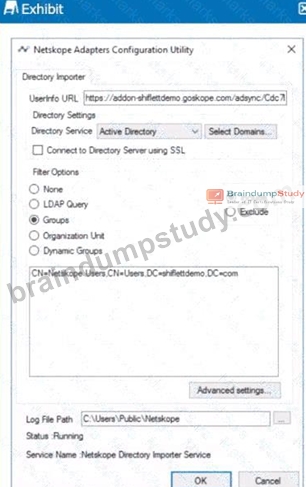
You installed Directory Importer and configured it to import specific groups ot users into your Netskope tenant as shown in the exhibit. One hour after a new user has been added to the domain, the user still has not been provisioned to Netskope.
What are three potential reasons for this failure? (Choose three.)
- A. The server that the Directory Importer is installed on is unable to reach Netskope's add-on endpomt.
- B. Directory Importer does not support ongoing user syncs; you must manually provision the user.
- C. The user is not a member of the group specified as a filter
- D. The default collection interval is 180 minutes, therefore a sync may not have run yet.
- E. Active Directory integration is not enabled on your tenant.
Answer: A,C,D
Explanation:
The three potential reasons for the failure of a new user not being provisioned to Netskope an hour after being added to the domain could be:
* B. The server that the Directory Importer is installed on is unable to reach Netskope's add-on endpoint:
If the server cannot connect to Netskope's endpoint, it cannot sync the user data. This could be due to network issues, incorrect configuration, or firewall restrictions1.
* C. The user is not a member of the group specified as a filter: The Directory Importer may be configured to import users from specific groups only. If the new user is not a member of these groups, they will not be imported into Netskope1.
* E. The default collection interval is 180 minutes, therefore a sync may not have run yet: The Directory Importer may be scheduled to sync every 180 minutes. If only an hour has passed, the sync process might not have occurred yet, and the user would not be provisioned until the next sync interval1.
These potential reasons are based on the standard operation and configuration of the Netskope Directory Importer as described in the Netskope Knowledge Portal and documentation
NEW QUESTION # 62
......
Our company is a professional copyright materials provider, and we have occupied in this field for years. Our company is in the leading position in exam materials providing. NSK300 exam materials of us have high pass rate, and you can pass it by using them, and money back guarantee for your failure. NSK300 Exam Materials have the questions and answers and therefore you can practice the question and check the answers in a quite convenient way. We also offer you free update for one year, and you can get the latest version timely if you buy the NSK300 exam dumps from us.
Brain NSK300 Exam: https://www.braindumpstudy.com/NSK300_braindumps.html
- 2026 Pass-Sure NSK300 Real Question | 100% Free Brain NSK300 Exam ???? The page for free download of ( NSK300 ) on ✔ www.vce4dumps.com ️✔️ will open immediately ????NSK300 New Study Notes
- 2026 NSK300 Real Question 100% Pass | Efficient Brain NSK300 Exam: Netskope Certified Cloud Security Architect ???? Simply search for ▶ NSK300 ◀ for free download on 《 www.pdfvce.com 》 ????Vce NSK300 Test Simulator
- NSK300 New Study Notes ???? New NSK300 Exam Question ???? NSK300 copyright Downloads ???? Search for 「 NSK300 」 on ➤ www.prepawayete.com ⮘ immediately to obtain a free download ????Exam NSK300 Questions
- 2026 Pass-Sure NSK300 Real Question | 100% Free Brain NSK300 Exam ???? Search for ⮆ NSK300 ⮄ and download it for free immediately on ▷ www.pdfvce.com ◁ ????New NSK300 Exam Simulator
- In the event that you fail the Netskope NSK300 exam, you will receive a refund ???? Easily obtain 《 NSK300 》 for free download through “ www.exam4labs.com ” ????Reliable NSK300 Test Syllabus
- NSK300 Latest Test Sample ???? NSK300 Exam Duration ???? New NSK300 Exam Price ☮ Immediately open ⮆ www.pdfvce.com ⮄ and search for ( NSK300 ) to obtain a free download ????Reliable NSK300 Exam Camp
- Verified NSK300 Answers ???? Reliable NSK300 Exam Camp ☁ NSK300 Downloadable PDF ⛳ Open ▛ www.torrentvce.com ▟ enter ⏩ NSK300 ⏪ and obtain a free download ????New NSK300 Exam Question
- New NSK300 Exam Question ???? Exam NSK300 Questions ???? New NSK300 Exam Simulator ???? Search for ⮆ NSK300 ⮄ and obtain a free download on ➽ www.pdfvce.com ???? ????NSK300 Exam Duration
- Netskope Certified Cloud Security Architect Updated Training Material - NSK300 Study Pdf Vce - Netskope Certified Cloud Security Architect Actual Exam Questions ???? ▛ www.pdfdumps.com ▟ is best website to obtain ⮆ NSK300 ⮄ for free download ⭕NSK300 Exam Duration
- NSK300 Downloadable PDF ⛽ Valid NSK300 Test Syllabus ???? New NSK300 Study Plan ???? Enter ☀ www.pdfvce.com ️☀️ and search for “ NSK300 ” to download for free ????NSK300 Exam Duration
- Top NSK300 Real Question 100% Pass | High-quality NSK300: Netskope Certified Cloud Security Architect 100% Pass ???? Simply search for ☀ NSK300 ️☀️ for free download on “ www.pdfdumps.com ” ????New NSK300 Exam Question
- janatmgo360919.p2blogs.com, lulumcck351408.dailyblogzz.com, 7bookmarks.com, honeywclt886839.ambien-blog.com, caoimhezgrg727184.blog2freedom.com, dynamicbangladesh.com, altbookmark.com, ihannaqzvp169587.mdkblog.com, thesocialcircles.com, haimanjkr278913.blognody.com, Disposable vapes
P.S. Free 2026 Netskope NSK300 dumps are available on Google Drive shared by BraindumpStudy: https://drive.google.com/open?id=1JwJJbpm2vaew-i3nmx0bqq6IO4pnvkHn
Report this wiki page